According to BigHit Music on the 25th, BTS maintained the No. 1 position for five consecutive weeks on Spotify’s “Weekly Top Albums Global” chart with ARIRANG. On the “Weekly Top Songs Global” chart, all 14 tracks from the album—including the title track “SWIM”—remained on the chart for five consecutive weeks. Notably, “SWIM” also reached No. 2 on the “Daily Top Songs Global” chart and held a top position for 35 consecutive days. In the domestic market as well as on charts across Europe, the UK, Australia, and נαραи, BTS also continued to achieve remarkable success.
Despite the achievements BTS have reached with ARIRANG, there has been no shortage of criticism suggesting that the group is gradually losing its K-pop identity. The BBC previously reported on this reaction from a portion of the public, noting that BTS “is caught between кσяєα and the world,” raising an underlying question: are they going too far from K-pop in their effort to conquer the global market?
The BBC particularly highlighted that although this album emphasizes кσяєαn roots, the final product did not meet expectations for some. “The heavy use of English and the eclectic producer credits” has become a “hot issue.” According to the BBC, following нιтs like “Dynamite,” “Butter,” and now the title track “Swim”—all of which prioritize English lyrics—there is a growing opinion that BTS and HYBE are trading uniqueness in pursuit of the lucrative Western market.

Against this backdrop, a recent interview with JoongAng provided a clearer internal perspective. Kim Hyun Jung (Nicole Kim)—Vice President of Big Hit Music and someone deeply involved in the production of ARIRANG—further clarified the reasoning behind the decision to prioritize English, in which US ARMY were surprisingly mentioned as a contributing factor.
Specifically, Nicole Kim stated: “The goal is to let as many people as possible hear the songs we worked so hard on.” She explained that in the past, overseas radio stations and platforms often did not favor playing tracks that were not in English. A well-known example is from the early days, when international fans—most notably US ARMY—went to great lengths to “plead” with radio stations to play BTS’s кσяєαn-language songs.
However, Vice President Kim also noted: “I believe this happened not because broadcasters were discriminating against the кσяєαn language, but rather because they had no choice but to prioritize languages more familiar to their listeners.” She added: “On the other hand, there were instances where English simply suited the music better. For example, regarding the title track 'SWIM,' the company, the members, and the producers brainstormed together, but using кσяєαn terms like 'Suyeong-hae' or 'Heeom-chyeo' (Swimming in кσяєαn) didn't quite capture the specific vibe of the song.”
Taking all of these factors into account, the team and BTS ultimately decided to incorporate more English into the songs on ARIRANG!
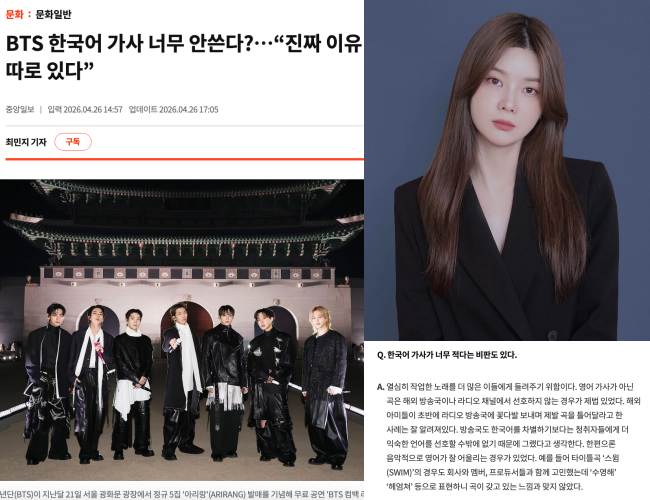
Notably, when ARIRANG was first released, Nicole Kim was also revealed to be the one behind the proposal to increase English lyrics. Vulture reported that during a meeting, SUGA and RM expressed their desire to include more кσяєαn rap verses because “authenticity matters,” but Nicole Kim pushed back, suggesting they needed to try this approach if they wanted the album to go global.
At the time, this stance made her the center of criticism, as many believed she was the main reason the album lacked кσяєαn elements, leading to disappointment. Even at the press conference following the album’s release, her explanation that “Arirang is the identity and the root of BTS. In order to deliver this message, we used both кσяєαn and English together so that as many people as possible could understand it” did not resonate with many.

However, with her latest remarks, she has clarified her perspective and that of the team more clearly, making it easier for fans to understand. The decision to prioritize English in ARIRANG is not simply a commercial strategy, but the result of multiple factors—from market realities and artistic direction to the journey shared with fans.
One αмєяι¢αn fan recalled how difficult it used to be to get кσяєαn songs by a K-pop group played on U.S. radio, writing: “Those were the days. We didn’t just give them a bouquet of flowers, we brought cupcakes, donuts, coffee, even wine, and sent thank you cards too. It was a difficult time, radio stations and DJs would hang up on us when we requested BTS songs.” Therefore, “Real ARMY never criticized their lyrical choices", she concluded.
Another fan expressed a similar view: “I can guarantee had ‘Swim’ been in кσяєαn, it would’ve gotten no radio play, therefore no stability on the charts for their long-awaited comeback, which means K media would’ve dragged them all over again saying they’re over—so it’s just like they can never win.”
Meanwhile, there are still opposing opinions such as, “So they should do songs to please the radios now?” or arguments that unless money is involved, English would not influence radio decisions. In response, another fan countered: “Didn’t you see this ARIRANG era is the time we got the biggest airplay in the US ever. But I won’t say it’s just because it’s in English—it’s also because the world has gotten more used to BTS and the opinion is while preparing the album with the experience they had previously had?” Another fan simply concluded: “They did the song they want to do but in English—what is your f*cking problem?”
Finally, to close the discussion, Bang Si-hyuk’s words offer a fitting perspective: “‘Arirang’ should never be treated as soмєтнing superficial or one-dimensional, nor reduced to a shallow slogan such as ‘including “Arirang” makes it somehow кσяєαn’ or ‘the most кσяєαn is the most global.’” He also clarified that the goal of this album was that “BTS 2.0 shouldn’t remain an extension of the past – it had to be a declaration that opens a new chapter,” and “to deeply respect the genre and musical traditions we come from – but never remain confined by them”.
In reality, the results have proven that this choice was not wrong and has achieved its intended effect. BTS have not only preserved their unique musical identity but have also continued to expand their global influence!