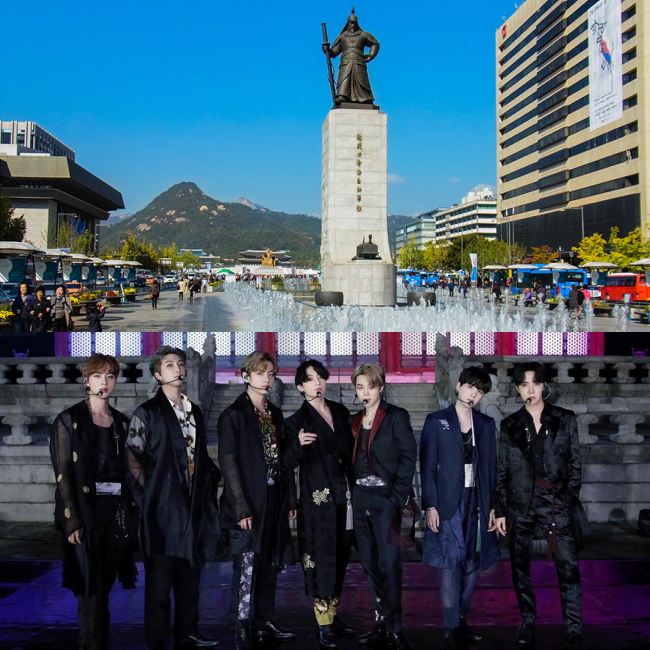
Three days ago, according to a report by Yonhap News, BTS are expected to make their comeback on March 20 with their first full-group performance in Seoul. The venue under consideration is none other than Gwanghwamun Square in Seoul, where BigHit Music had previously installed an art installation to promote the album ARIRANG. Au∂ιєnce members are expected to be selected through advance registration, with the estimated number of attendees ranging from approximately 15,000 to 20,000.
According to кσяєαn media, HYBE prioritized Gwanghwamun Square to add greater symbolic meaning to BTS’s return, and also submitted applications to use surrounding areas such as Gyeongbokgung Palace and Sungnyemun for a program tentatively titled "K-Heritage and K-POP Fusion Performance". HYBE is also reported to be in discussions with relevant authorities, including the Seoul Metropolitan Government, the ρσℓι¢є, and the Cultural Heritage Administration.
In a statement to Xports News on the 19th, BigHit Music stated only that BTS’s first comeback concert is “currently under discussion” and that “an official announcement will be made once the venue and schedule are finalized.”
On the afternoon of the 22nd, city officials issued an official response to the media regarding the report, stating that at "1st Gwanghwamun Square Advisory Group Meeting of 2026," they decided to grant conditional use permission for the "BTS 2026 Comeback Show @Seoul" requested by HYBE and BigHit Music.
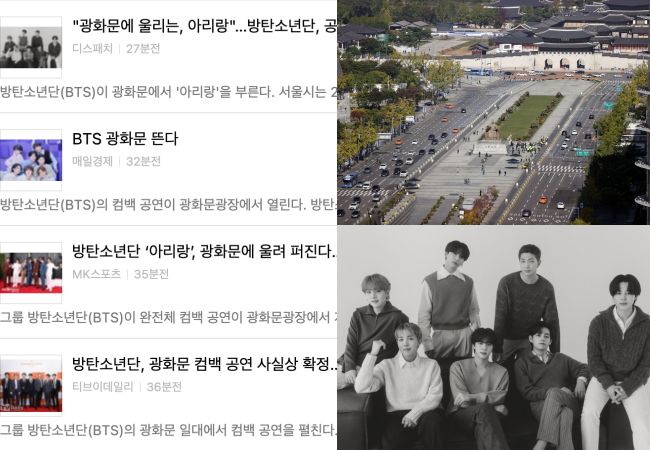
On the condition of pαѕѕing the safety management plan review, the city plans to swiftly issue the permit once supplementary measures are finalized. These include preventing overlapping exit times for performers and spectators and minimizing traffic congestion.
As a mαѕѕive crowd is expected to gather in the downtown area, including Gwanghwamun Square, on the day of the event, the Seoul Metropolitan Government will closely review safety management plans and cooperate with related agencies such as the ρσℓι¢є and Jongno-gu Office to ensure visitor safety as the top priority.
The city also intends to conduct thorough on-site inspections for unfair practices, such as excessive accommodation fees (price gouging), as well as general citizen safety and surrounding traffic. Inspections will center on Jongno-gu (280 locations) and Jung-gu (411 locations), which are adjacent to Gwanghwamun Square. Through these pre-inspections, the city aims to minimize inconvenience for both citizens and tourists visiting Seoul for the show.
Furthermore, on the day of the performance, the city plans to operate various experiential programs for foreign tourists, including the BTS fandom, ARMY. To celebrate BTS’s return, a welcoming atmosphere will be created throughout Seoul, offering entertainment through programs that combine K-pop with Hallyu (кσяєαn Wave) content.
Kim Chang-gyu, Head of the Seoul Balanced Development Headquarters, stated, "We will review and implement management plans with the safety of citizens and tourists as our utmost priority. We will prepare a variety of events so visitors can fully experience the charm of Seoul, turning Gwanghwamun Square into a true K-pop landmark."
Once the news was confirmed, fans expressed overwhelming excitement over BTS’s first group performance in three years taking place at a historically significant location. Opening a new chapter—one symbolizing rebirth—at a site named after King Sejong, the most revered monarch in кσяєαn history, carries profound cultural significance. The event further reinforces BTS’s role as a national symbol and a driving force shaping South кσяєα’s cultural influence in the 21st century.
Attention on Seoul this coming March is intensifying more than ever, as BTS are also set to kick off the first concert of their 2026 global tour in early April at Goyang’s main stadium. Data show that searches for travel to South кσяєα surged sharply following news of the Gwanghwamun performance and the concert series in Goyang and Busan.
According to data from Hotels.com, compared to the week immediately before the tour announcement (January 6–7), travel searches for Seoul on January 13–14 increased by 155%, while searches for Busan skyrocketed by 2,375%. For Seoul, searches from נαραи recorded the highest growth (+400%), followed by Taiwan (+260%), Hong Kong (+170%), and the United States (+95%). For Busan, international travel searches were led by נαραи with a record surge (+10,545%), followed by Hong Kong (+7,100%), Taiwan (+1,275%), and the United States (+835%).