The BBC reported on the 13th (local time) that BTS is expected to generate USD 1 billion (approximately 1.4767 trillion won) from its comeback tour after a four-year hiatus. During their previous tour, BTS earned USD 246 million (approximately 363.3 billion won), setting the highest record in K-pop history. Notably, as the members have not performed outside the United States and South кσяєα since 2019, this tour is expected to receive the most intense response yet from global fans who have been “starving” to see the group.
The tour will kick off with three nights at Goyang Stadium in South кσяєα starting on April 9, 2026, before continuing across Asia, Europe, and the United States, stopping in major cities worldwide for a total of 79 shows. The tour has been described as “the highest number of shows for a single tour by a K-pop artist.” BigHit Music also added, “The scale of the tour is expected to expand even further as schedules for נαραи and the Middle East are set to be added in the future.”

BTS will also set several new milestones, including performances at Sun Bowl Stadium in El Paso, Texas, and Gillette Stadium in Foxborough, Mαѕѕachusetts, making them the first K-pop act to perform at both venues. Another landmark achievement is BTS taking the stage at Stanford Stadium in California, becoming the second artist ever to perform there after British band Coldplay. The itinerary also includes AT&T Stadium in Arlington, Texas—the world’s largest domed stadium—and M&T Bank Stadium in Baltimore, Maryland, where BTS will become the first кσяєαn artist to headline the venue.
Beyond its mαѕѕive scale, the tour’s concert quality is also being elevated to a new level, as BigHit Music announced the adoption of a 360-degree ‘in-the-round’ stage design—the first time such a setup has been used in a stadium tour by a K-pop artist—drawing widespread amazement from fans and online communities alike. However, what surprised many was that SUGA and Jimin had actually hinted at this news long ago during a previous conversation.
On the day the news was widely announced, a video capturing a conversation between SUGA and Jimin resurfaced and quickly went viral again. Upon rewatching the clip, fans realized that the body language and dialogue between the two members at the final concert of j-hope in Seoul last June were, in fact, about the idea of setting up a 360-degree stage.
Under the viral video—which has amαѕѕed hundreds of thousands of views—fans expressed their excitement through enthusiastic reactions:
- im screaming it really looked like yoongi was telling jimin about the 360 degree stage theyll have in their world tour widhekeheekehe
- everyone owes yoongi an apology: the man wasn’t bullshitting here, he was six months pregnant with the concept of the 360° x-shaped stage
- Yoongi: We'll perform on a 360 degree stage so every army can witness our amazing αѕѕes. It'll be fun to see them going insane.
- They were leaving hints we didn't pick up on lol
- Once again the spoilers were always there but we are really blind
- me staring at this like I’m analyzing BTS stage blocking… trying to stay normal but one lighting cue and I’m GONE — and I know they’re already cooking an even crazier setup
- Yoongi is a Pisces guy, his creativity and vision always way far ahead
- kings of dropping spoilers right infront of our noses
- when you're a canonical bullsнιтter and people easily misunderstand your big gesture
Meanwhile, a 360-degree seating arrangement surrounding the stage allows for a significantly larger au∂ιєnce compared to traditional concert layouts. With a 360-degree stage, capacity can increase by as much as 30,000–35,000 seats per venue, potentially amounting to approximately 3 million tickets across 36 shows. Several 360-degree stage seating charts for stadiums on BTS’s world tour itinerary have also been revealed, including:
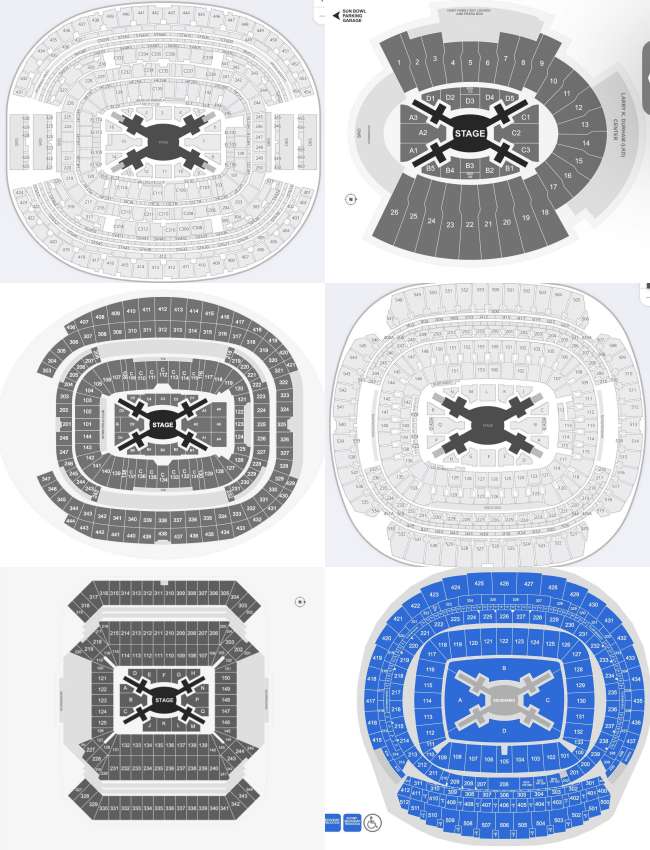
Experts predict that the new seating configuration will help BTS become the best-selling K-pop touring act of all time, with at least 2.3 million tickets expected to be released. Implementing this new stage setup at stadium-scale venues also demonstrates the group’s extraordinary ability to mobilize au∂ιєnces, aligning with BigHit Music’s αѕѕessment that “BTS’s popularity is not confined to a single region but is spreading widely across the globe.”
Beyond commercial considerations, this stage design is also intended to place the au∂ιєnce at the center of the entire experience. It is seen as BTS’s effort to break down all barriers of distance, allowing the group to fully connect with every fan and deliver the most genuine moments possible after a long four-year wait.